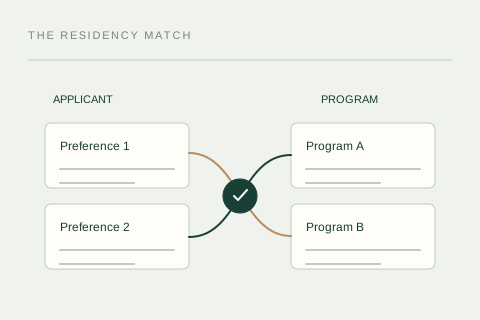
The National Resident Matching Program (NRMP) runs the Main Residency Match, the system most U.S. MD and DO graduates and many international medical graduates use to get their first residency position. Applicants and programs each submit a ranked list of preferences, and a mathematical algorithm places applicants in positions. For most people, passing USMLE Step 1 and Step 2 CK is what makes it possible to enter the Match.
How the Match works
- Apply to programs through ERAS (or ResidencyCAS for participating specialties).
- Register separately with the NRMP in its R3 system. ERAS and NRMP are different organizations with different fees.
- Interview with programs, usually October to January.
- Rank the programs where you interviewed, in true order of preference, and certify your rank order list before the deadline.
- Match Week: find out whether you matched, take part in SOAP if eligible, and learn where you matched on Match Day.
The algorithm in plain language
The Match uses an applicant-proposing algorithm. It tries to place you in your most preferred program first. If that program has ranked you and has room, you are tentatively matched there. If it is full with candidates it prefers, the algorithm tries your next choice, and so on.
What this means for you: rank programs in the order you actually prefer them. Ranking a "safer" program higher never improves your chances elsewhere. It only risks placing you somewhere you like less. Rank every program you would genuinely be willing to attend, and none that you would not.
Key dates: 2027 Main Residency Match
| Date | Event |
|---|---|
| June 2026 | MyERAS opens for the 2027 season so you can build your application |
| September 2, 2026 | ERAS applicants can submit applications to programs |
| September 15, 2026 | NRMP registration opens for applicants |
| September 23, 2026 | Programs can review ERAS applications; MSPEs are released |
| October 2026 – January 2027 | Interview season |
| January 29, 2027 | Standard NRMP registration deadline; a $50 late fee applies after this date |
| February 1, 2027 | Ranking opens |
| March 3, 2027 (9 p.m. ET) | Rank order list certification deadline; this is also the late registration deadline |
| March 15, 2027 (10 a.m. ET) | Match Week begins: applicants learn whether they matched; SOAP begins |
| March 18, 2027 | SOAP offer rounds (four rounds during the day) |
| March 19, 2027 (12 p.m. ET) | Match Day: applicants learn where they matched |
What it costs
- $85 registration fee, covering up to 20 unique programs on your primary rank order list and up to 20 on any supplemental lists combined.
- $30 for each additional unique program beyond 20, up to 300 ranks.
- An extra fee for very long lists of 100 ranks or more.
- $45 per partner for couples.
- $50 late registration fee after January 29.
All NRMP fees are non-refundable. ERAS application fees are separate and are charged per program.
Building your rank order list
- Primary list: the programs you want most, in true preference order.
- Supplemental lists: if you rank advanced positions that start in PGY-2, such as dermatology, radiology, or anesthesiology at some programs, you can attach supplemental lists of preliminary or transitional-year positions for your first year.
- Couples: two applicants can link their lists so they match as a pair of programs. They rank pairs of programs, including combinations where one partner is unmatched.
- Length matters: NRMP data consistently show that applicants who rank more programs are more likely to match. Rank every program you would be happy to attend.
The rules: a binding commitment
When you register, you accept the Match Participation Agreement. The most important point: a match is binding. If you match, you are committed to start training at that program, and the program is committed to offer you a position. Backing out without an NRMP waiver is a Match violation, and violations can lead to penalties, including being barred from future Matches.
The communication rules protect you too. Programs may not ask you to reveal where you intend to rank them, or ask for a commitment. You may express interest honestly, but you should never make a promise you do not intend to keep.
Under the All In Policy, programs that take part in the Main Residency Match must register and try to fill all of their positions through the Match or another national matching plan. Very few positions are offered outside the Match.
If you do not match: SOAP
The Supplemental Offer and Acceptance Program (SOAP) runs during Match Week. It lets eligible unmatched or partially matched applicants apply to positions still unfilled after the algorithm runs.
- You learn your status on the Monday of Match Week and see the list of unfilled programs.
- You apply through ERAS to a limited number of SOAP programs, which may contact you for virtual interviews.
- Offers are made in rounds through R3. Accepting a SOAP offer is binding, just like a match.
- During SOAP, applicants and programs must use the SOAP process rather than making arrangements outside it.
For international medical graduates
- ECFMG requirements: IMGs must complete the medical science examination, clinical skills, and communication skills requirements for ECFMG Certification by the rank order list certification deadline (March 3, 2027) to take part in the Match. NRMP checks your status with ECFMG every week, and your R3 record changes from "Not Verified" to "Verified" once the requirements are met. Verification status appears from mid-October.
- Visas: before you certify your list, confirm that each program will sponsor the visa type you need (J-1 through ECFMG, or H-1B). Many programs sponsor only the J-1. Ask directly during interviews, and be clear about your current and expected visa needs.
- ERAS tokens: IMGs get their ERAS token through ECFMG/Intealth rather than a U.S. medical school.
- Strengthen your application: strong Step 2 CK performance, U.S. clinical experience, and U.S. letters of recommendation are especially important for IMGs.
After you match
Your program will send a contract and onboarding requirements, which can include background checks, a training license application, credentialing, and for IMGs, visa processing. Start early and keep your documents organized. Most residencies begin around July 1.
Other matching programs
Some specialties use separate matches with different calendars: ophthalmology (SF Match), urology (AUA), and the military match. After residency, many fellowships use the NRMP's Specialties Matching Service. Check the rules for your specialty early.